


CHAPTER 62
House Bill No. 2444
(Amended by Chapter 155)
An Act concerning crimes, punishment and criminal procedure; providing that jail credit when consecutive sentences are imposed shall not apply to more than one case; creating a special sentencing rule of presumptive imprisonment when a new felony is committed by certain offenders while in custody for a prior nondrug felony or on probation, parole or postrelease supervision for a prior nondrug felony; prohibiting certain dispositional and durational departures when a new felony is committed by offenders while in custody for a prior felony or on probation, parole or postrelease supervision for a prior felony; relating to release prior to trial; providing limitations and restrictions on releasing a person charged with a felony upon the person’s own recognizance; requiring secured minimum appearance bond amounts for certain defendants who commit a new felony while on probation, parole, postrelease supervision or bond for a prior felony unless the court makes certain findings; creating a presumption that certain noncitizens are a flight risk; amending K.S.A. 21-6818 and K.S.A. 2025 Supp. 21-6615, 21-6804 and 22-2802 and repealing the existing sections.
Be it enacted by the Legislature of the State of Kansas:
Section 1. K.S.A. 2025 Supp. 21-6615 is hereby amended to read as follows: 21-6615. (a) (1) In any criminal action in which the defendant is convicted, the judge, if the judge sentences the defendant to confinement, shall direct that for the purpose of computing the defendant’s sentence and parole eligibility and conditional release dates thereunder, that such sentence is to be computed from a date, to be specifically designated by the court in the sentencing order of the journal entry of judgment. Such date shall be established to reflect and shall be computed as an allowance for the time that the defendant has spent incarcerated pending the disposition of the defendant’s case. The defendant shall be entitled to have credit applied for each day spent incarcerated. In recording the commencing date of such sentence the date as specifically set forth by the court shall be used as the date of sentence and all good time allowances as are authorized by the secretary of corrections are to be allowed on such sentence from such date as though the defendant were actually incarcerated in any of the institutions of the state correctional system.
(2) When computing the defendant’s sentence, the following shall not be considered time spent incarcerated pending disposition of the defendant’s case:
(A) Any time awarded as credit in another case when consecutive sentences are imposed on a defendant, consistent with subsection (d); or
(B) any time spent incarcerated in another jurisdiction if no hold has been issued in such jurisdiction for the case being sentenced.
(b) In any criminal action in which probation or assignment to community corrections is revoked and the defendant is sentenced to confinement, for the purpose of computing the defendant’s sentence and parole eligibility and conditional release date, the defendant’s sentence is to be computed from a date, hereafter to be specifically designated in the sentencing order of the journal entry of judgment. Such date shall be established to reflect and shall be computed as an allowance for the time that the defendant has spent in a residential facility while on probation or assignment to community correctional residential services program. The commencing date of such sentence shall be used as the date of sentence and all good time allowances as are authorized by law are to be allowed on such sentence from such date as though the defendant were actually incarcerated in a correctional institution.
(c) Such credit is not to be considered to reduce the minimum or maximum terms of confinement authorized by law for the offense of which the defendant has been convicted.
(d) (1) When consecutive sentences are imposed on a defendant, days spent in custody that are attributable to more than one case shall be credited only once against the aggregated consecutive term. The sentencing court may allocate such days to one case or apportion such days among cases, but the same days shall not be applied more than once to reduce multiple portions of consecutive terms.
(2) The provisions of this subsection shall apply to:
(A) All sentences, whether pronounced before, on or after July 1, 2026, and to all computations of jail credit by the department of corrections and the courts; and
(B) any case posture, including, but not limited to, direct appeals, probation revocation proceedings, motions to correct illegal sentence, habeas corpus actions and actions under K.S.A. 60-1507, and amendments thereto, pending on or filed after July 1, 2026.
(3) Any judicial interpretations regarding application of jail time credit to consecutive sentences in conflict with or inconsistent with this section and the amendments to this section by this act are superseded to the extent of such conflict or inconsistency.
Sec. 2. K.S.A. 2025 Supp. 21-6804 is hereby amended to read as follows: 21-6804. (a) The provisions of this section shall be applicable to the sentencing guidelines grid for nondrug crimes. The following sentencing guidelines grid shall be applicable to nondrug felony crimes:
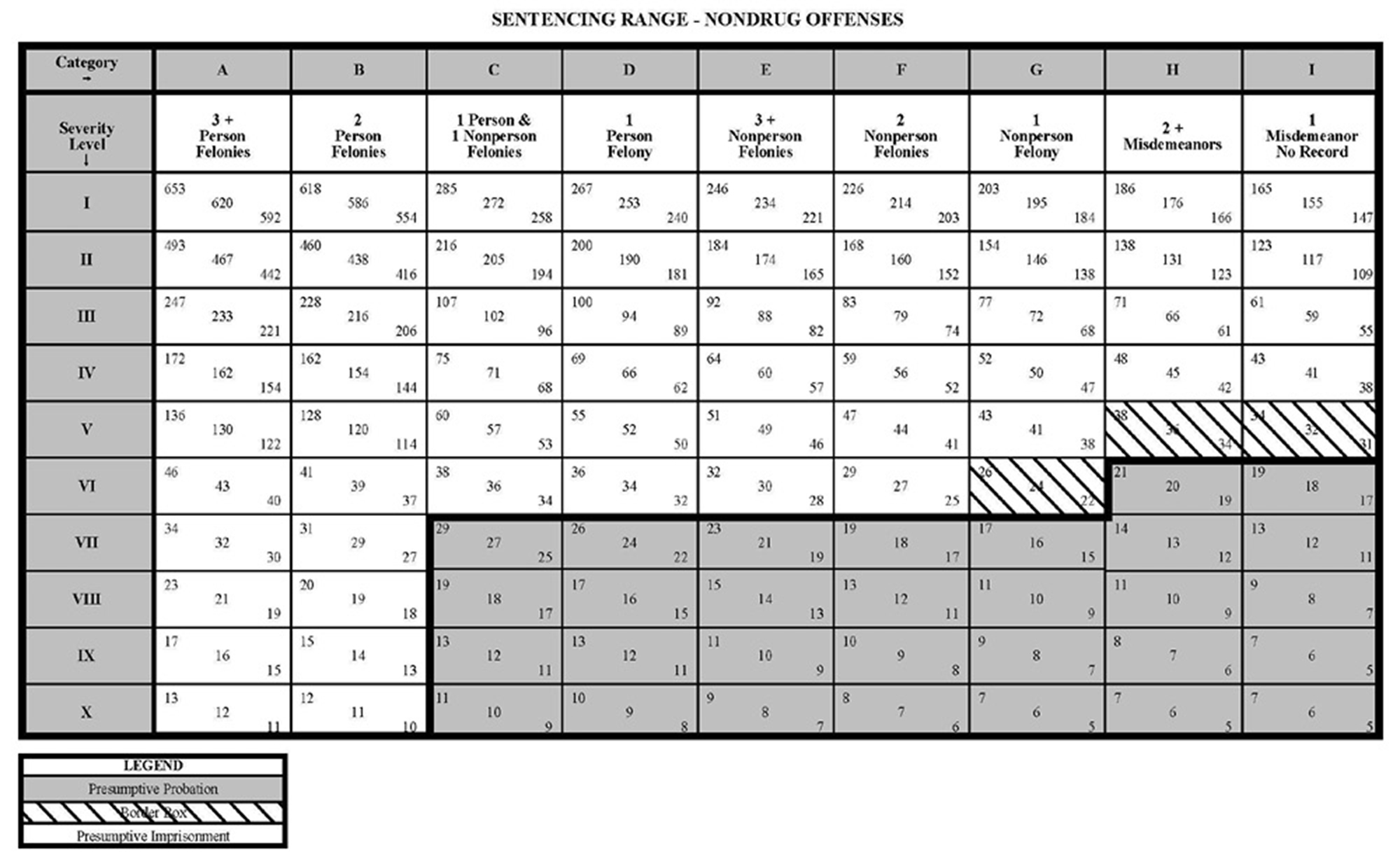
(b) Sentences expressed in the sentencing guidelines grid for nondrug crimes represent months of imprisonment.
(c) The sentencing guidelines grid is a two-dimensional crime severity and criminal history classification tool. The grid’s vertical axis is the crime severity scale which classifies current crimes of conviction. The grid’s horizontal axis is the criminal history scale which classifies criminal histories.
(d) The sentencing guidelines grid for nondrug crimes as provided in this section defines presumptive punishments for felony convictions, subject to the sentencing court’s discretion to enter a departure sentence. The appropriate punishment for a felony conviction should depend on the severity of the crime of conviction when compared to all other crimes and the offender’s criminal history.
(e) (1) The sentencing court has discretion to sentence at any place within the sentencing range. In the usual case it is recommended that the sentencing judge select the center of the range and reserve the upper and lower limits for aggravating and mitigating factors insufficient to warrant a departure.
(2) In presumptive imprisonment cases, the sentencing court shall pronounce the complete sentence which shall include the:
(A) Prison sentence;
(B) maximum potential reduction to such sentence as a result of good time; and
(C) period of postrelease supervision at the sentencing hearing. Failure to pronounce the period of postrelease supervision shall not negate the existence of such period of postrelease supervision.
(3) In presumptive nonprison cases, the sentencing court shall pronounce the:
(A) Prison sentence; and
(B) duration of the nonprison sanction at the sentencing hearing.
(f) Each grid block states the presumptive sentencing range for an offender whose crime of conviction and criminal history place such offender in that grid block. If an offense is classified in a grid block below the dispositional line, the presumptive disposition shall be nonimprisonment. If an offense is classified in a grid block above the dispositional line, the presumptive disposition shall be imprisonment. If an offense is classified in grid blocks 5-H, 5-I or 6-G, the court may impose an optional nonprison sentence as provided in subsection (q).
(g) The sentence for a violation of K.S.A. 21-3415, prior to its repeal, aggravated battery against a law enforcement officer committed prior to July 1, 2006, or a violation of K.S.A. 21-5412(d), and amendments thereto, aggravated assault against a law enforcement officer, which places the defendant’s sentence in grid block 6-H or 6-I shall be presumed imprisonment. The court may impose an optional nonprison sentence as provided in subsection (q).
(h) When a firearm is used to commit any person felony, the offender’s sentence shall be presumed imprisonment. The court may impose an optional nonprison sentence as provided in subsection (q).
(i) (1) The sentence for the violation of the felony provision of K.S.A. 21-5414(c)(1)(C), 21-5823(b)(3) and (b)(4), 21-6412 and 21-6416, and amendments thereto, shall be as provided by the specific mandatory sentencing requirements of that section and shall not be subject to the provisions of this section or K.S.A. 21-6807, and amendments thereto.
(2) If because of the offender’s criminal history classification the offender is subject to presumptive imprisonment or if the judge departs from a presumptive probation sentence and the offender is subject to imprisonment, the provisions of this section and K.S.A. 21-6807, and amendments thereto, shall apply and the offender shall not be subject to the mandatory sentence as provided in K.S.A. 21-5823, and amendments thereto.
(3) Notwithstanding the provisions of any other section, the term of imprisonment imposed for the violation of the felony provision of K.S.A. 21-5414(c)(1)(C), 21-5823(b)(3) and (b)(4), 21-6412 and 21-6416, and amendments thereto, shall not be served in a state facility in the custody of the secretary of corrections. Prior to imposing any sentence pursuant to this subsection, the court may consider assigning the defendant to a house arrest program pursuant to K.S.A. 21-6609, and amendments thereto.
(j) (1) The sentence for any persistent sex offender whose current convicted crime carries a presumptive term of imprisonment shall be double the maximum duration of the presumptive imprisonment term. The sentence for any persistent sex offender whose current conviction carries a presumptive nonprison term shall be presumed imprisonment and shall be double the maximum duration of the presumptive imprisonment term.
(2) Except as otherwise provided in this subsection, as used in this subsection, “persistent sex offender” means a person who:
(A) (i) Has been convicted in this state of a sexually violent crime, as defined in K.S.A. 22-3717, and amendments thereto; and
(ii) at the time of the conviction under clause (i) has at least one conviction for a sexually violent crime, as defined in K.S.A. 22-3717, and amendments thereto, in this state or comparable felony under the laws of another state, the federal government or a foreign government; or
(B) (i) has been convicted of rape, as defined in K.S.A. 21-3502, prior to its repeal, or K.S.A. 21-5503, and amendments thereto; and
(ii) at the time of the conviction under clause (i) has at least one conviction for rape in this state or comparable felony under the laws of another state, the federal government or a foreign government.
(3) Except as provided in subsection (j)(2)(B), the provisions of this subsection shall not apply to any person whose current convicted crime is a severity level 1 or 2 felony.
(k) (1) If it is shown at sentencing that the offender committed any felony violation for the benefit of, at the direction of, or in association with any criminal street gang, with the specific intent to promote, further or assist in any criminal conduct by gang members, the offender’s sentence shall be presumed imprisonment. The court may impose an optional nonprison sentence as provided in subsection (q).
(2) As used in this subsection, “criminal street gang” means any organization, association or group of three or more persons, whether formal or informal, having as one of its primary activities:
(A) The commission of one or more person felonies; or
(B) the commission of felony violations of article 57 of chapter 21 of the Kansas Statutes Annotated, and amendments thereto, K.S.A. 2010 Supp. 21-36a01 through 21-36a17, prior to their transfer, or any felony violation of any provision of the uniform controlled substances act prior to July 1, 2009; and
(C) its members have a common name or common identifying sign or symbol; and
(D) its members, individually or collectively, engage in or have engaged in the commission, attempted commission, conspiracy to commit or solicitation of two or more person felonies or felony violations of article 57 of chapter 21 of the Kansas Statutes Annotated, and amendments thereto, K.S.A. 2010 Supp. 21-36a01 through 21-36a17, prior to their transfer, any felony violation of any provision of the uniform controlled substances act prior to July 1, 2009, or any substantially similar offense from another jurisdiction.
(l) Except as provided in subsection (o), the sentence for a violation of K.S.A. 21-5807(a)(1), and amendments thereto, or any attempt or conspiracy, as defined in K.S.A. 21-5301 and 21-5302, and amendments thereto, to commit such offense, when such person being sentenced has a prior conviction for a violation of K.S.A. 21-3715(a) or (b), prior to its repeal, 21-3716, prior to its repeal, K.S.A. 21-5807(a)(1) or (a)(2) or 21-5807(b), and amendments thereto, or any attempt or conspiracy to commit such offense, shall be presumptive imprisonment.
(m) The sentence for a violation of K.S.A. 22-4903 or K.S.A. 21-5913(a)(2), and amendments thereto, shall be presumptive imprisonment. If an offense under such sections is classified in grid blocks 5-E, 5-F, 5-G, 5-H or 5-I, the court may impose an optional nonprison sentence as provided in subsection (q).
(n) The sentence for a violation of criminal deprivation of property, as defined in K.S.A. 21-5803, and amendments thereto, when such property is a motor vehicle, and when such person being sentenced has any combination of two or more prior convictions of K.S.A. 21-3705(b), prior to its repeal, or of criminal deprivation of property, as defined in K.S.A. 21-5803, and amendments thereto, when such property is a motor vehicle, shall be presumptive imprisonment. Such sentence shall not be considered a departure and shall not be subject to appeal.
(o) (1) The sentence for a felony violation of theft of property as defined in K.S.A. 21-5801, and amendments thereto, or burglary as defined in K.S.A. 21-5807(a), and amendments thereto, when such person being sentenced has no prior convictions for a violation of K.S.A. 21-3701 or 21-3715, prior to their repeal, or theft of property as defined in K.S.A. 21-5801, and amendments thereto, or burglary as defined in K.S.A. 21-5807(a), and amendments thereto; or the sentence for a felony violation of theft of property as defined in K.S.A. 21-5801, and amendments thereto, when such person being sentenced has one or two prior felony convictions for a violation of K.S.A. 21-3701, 21-3715 or 21-3716, prior to their repeal, or theft of property as defined in K.S.A. 21-5801, and amendments thereto, or burglary or aggravated burglary as defined in K.S.A. 21-5807, and amendments thereto; or the sentence for a felony violation of burglary as defined in K.S.A. 21-5807(a), and amendments thereto, when such person being sentenced has one prior felony conviction for a violation of K.S.A. 21-3701, 21-3715 or 21-3716, prior to their repeal, or theft of property as defined in K.S.A. 21-5801, and amendments thereto, or burglary or aggravated burglary as defined in K.S.A. 21-5807, and amendments thereto, shall be the sentence as provided by this section, except that the court may order an optional nonprison sentence for a defendant to participate in a drug treatment program, including, but not limited to, an approved aftercare plan, if the court makes the following findings on the record:
(A) Substance abuse was an underlying factor in the commission of the crime;
(B) substance abuse treatment in the community is likely to be more effective than a prison term in reducing the risk of offender recidivism; and
(C) participation in an intensive substance abuse treatment program will serve community safety interests.
(2) A defendant sentenced to an optional nonprison sentence under this subsection shall be supervised by community correctional services. The provisions of K.S.A. 21-6824(f)(1), and amendments thereto, shall apply to a defendant sentenced under this subsection. The sentence under this subsection shall not be considered a departure and shall not be subject to appeal.
(p) (1) The sentence for a felony violation of theft of property as defined in K.S.A. 21-5801, and amendments thereto, when such person being sentenced has any combination of three or more prior felony convictions for violations of K.S.A. 21-3701, 21-3715 or 21-3716, prior to their repeal, or theft of property as defined in K.S.A. 21-5801, and amendments thereto, or burglary or aggravated burglary as defined in K.S.A. 21-5807, and amendments thereto; or the sentence for a violation of burglary as defined in K.S.A. 21-5807(a), and amendments thereto, when such person being sentenced has any combination of two or more prior convictions for violations of K.S.A. 21-3701, 21-3715 and 21-3716, prior to their repeal, or theft of property as defined in K.S.A. 21-5801, and amendments thereto, or burglary or aggravated burglary as defined in K.S.A. 21-5807, and amendments thereto, shall be presumed imprisonment and the defendant shall be sentenced to prison as provided by this section, except that the court may recommend that an offender be placed in the custody of the secretary of corrections, in a facility designated by the secretary to participate in an intensive substance abuse treatment program, upon making the following findings on the record:
(A) Substance abuse was an underlying factor in the commission of the crime;
(B) substance abuse treatment with a possibility of an early release from imprisonment is likely to be more effective than a prison term in reducing the risk of offender recidivism; and
(C) participation in an intensive substance abuse treatment program with the possibility of an early release from imprisonment will serve community safety interests by promoting offender reformation.
(2) The intensive substance abuse treatment program shall be determined by the secretary of corrections, but shall be for a period of at least four months. Upon the successful completion of such intensive treatment program, the offender shall be returned to the court and the court may modify the sentence by directing that a less severe penalty be imposed in lieu of that originally adjudged within statutory limits. If the offender’s term of imprisonment expires, the offender shall be placed under the applicable period of postrelease supervision. The sentence under this subsection shall not be considered a departure and shall not be subject to appeal.
(q) (1) As used in this section, an “optional nonprison sentence” is a sentence which the court may impose, in lieu of the presumptive sentence, upon making the following findings on the record:
(A) An appropriate treatment program exists which is likely to be more effective than the presumptive prison term in reducing the risk of offender recidivism; and
(B) the recommended treatment program is available and the offender can be admitted to such program within a reasonable period of time; or
(C) the nonprison sanction will serve community safety interests by promoting offender reformation.
(2) Any decision made by the court regarding the imposition of an optional nonprison sentence shall not be considered a departure and shall not be subject to appeal.
(r) The sentence for a violation of K.S.A. 21-5413(c)(2), and amendments thereto, shall be presumptive imprisonment and shall be served consecutively to any other term or terms of imprisonment imposed. Such sentence shall not be considered a departure and shall not be subject to appeal.
(s) The sentence for a violation of K.S.A. 21-5512, and amendments thereto, shall be presumptive imprisonment. Such sentence shall not be considered a departure and shall not be subject to appeal.
(t) (1) If the trier of fact makes a finding beyond a reasonable doubt that an offender wore or used ballistic resistant material in the commission of, or attempt to commit, or flight from any felony, in addition to the sentence imposed pursuant to the Kansas sentencing guidelines act, the offender shall be sentenced to an additional 30 months’ imprisonment.
(2) The sentence imposed pursuant to paragraph (1) shall be presumptive imprisonment and shall be served consecutively to any other term or terms of imprisonment imposed. Such sentence shall not be considered a departure and shall not be subject to appeal.
(3) As used in this subsection, “ballistic resistant material” means any:
(A) Commercially produced material designed with the purpose of providing ballistic and trauma protection, including, but not limited to, bulletproof vests and kevlar vests; and
(B) homemade or fabricated substance or item designed with the purpose of providing ballistic and trauma protection.
(u) The sentence for a violation of K.S.A. 21-6107, and amendments thereto, or any attempt or conspiracy, as defined in K.S.A. 21-5301 and 21-5302, and amendments thereto, to commit such offense, when such person being sentenced has a prior conviction for a violation of K.S.A. 21-4018, prior to its repeal, or K.S.A. 21-6107, and amendments thereto, or any attempt or conspiracy to commit such offense, shall be presumptive imprisonment. Such sentence shall not be considered a departure and shall not be subject to appeal.
(v) The sentence for a third or subsequent violation of K.S.A. 8-1568, and amendments thereto, shall be presumptive imprisonment and shall be served consecutively to any other term or terms of imprisonment imposed. Such sentence shall not be considered a departure and shall not be subject to appeal.
(w) The sentence for aggravated criminal damage to property as defined in K.S.A. 21-5813(b), and amendments thereto, when such person being sentenced has a prior conviction for any nonperson felony shall be presumptive imprisonment. Such sentence shall not be considered a departure and shall not be subject to appeal.
(x) The sentence for a violation of K.S.A. 21-5807(a)(1), and amendments thereto, shall be presumptive imprisonment if the offense under such paragraph is classified in grid blocks 7-C, 7-D or 7-E. Such sentence shall not be considered a departure and shall not be subject to appeal.
(y) (1) Except as provided in paragraph (3), if the trier of fact makes a finding beyond a reasonable doubt that an offender committed a nondrug felony offense, or any attempt or conspiracy, as defined in K.S.A. 21-5301 and 21-5302, and amendments thereto, to commit a nondrug felony offense, against a law enforcement officer, as defined in K.S.A. 21-5111(p)(1) and (3), and amendments thereto, while such officer was engaged in the performance of such officer’s duty, or in whole or in any part because of such officer’s status as a law enforcement officer, the sentence for such offense shall be:
(A) If such offense is classified in severity level 2 through 10, one severity level above the appropriate level for such offense; and
(B) (i) if such offense is classified in severity level 1, except as otherwise provided in clause (ii), imprisonment for life, and such offender shall not be eligible for probation or suspension, modification or reduction of sentence. In addition, such offender shall not be eligible for parole prior to serving 25 years’ imprisonment, and such 25 years’ imprisonment shall not be reduced by the application of good time credits. No other sentence shall be permitted.
(ii) The provisions of clause (i) requiring the court to impose a mandatory minimum term of imprisonment of 25 years shall not apply if the court finds the offender, because of the offender’s criminal history classification, is subject to presumptive imprisonment and the sentencing range exceeds 300 months. In such case, the offender is required to serve a mandatory minimum term equal to the sentence established pursuant to the sentencing range.
(2) The sentence imposed pursuant to paragraph (1) shall not be considered a departure and shall not be subject to appeal.
(3) The provisions of this subsection shall not apply to an offense described in paragraph (1) if the factual aspect concerning a law enforcement officer is a statutory element of such offense.
(z) (1) Notwithstanding K.S.A. 21-5109(b)(2), and amendments thereto, or any other provision of law to the contrary, the sentence for a violation of criminal possession of a weapon by a convicted felon as defined in K.S.A. 21-6304, and amendments thereto, shall be presumptive imprisonment and shall be served consecutively to any other term or terms of imprisonment imposed if the trier of fact makes a finding beyond a reasonable doubt that:
(A) The weapon the offender possessed during such violation was a firearm; and
(B) such firearm was used by the offender during the commission of any violent felony.
(2) The sentence imposed pursuant to paragraph (1) shall not be considered a departure and shall not be subject to appeal. No other sentence shall be permitted.
(3) The provisions of this subsection shall not apply to an offender who is prohibited from possessing a weapon pursuant to K.S.A. 21-6304, and amendments thereto, as a result of a juvenile adjudication.
(4) As used in this subsection, “violent felony” means any of the following:
(A) Capital murder, as defined in K.S.A. 21-5401, and amendments thereto;
(B) murder in the first degree, as defined in K.S.A. 21-5402, and amendments thereto;
(C) murder in the second degree, as defined in K.S.A. 21-5403, and amendments thereto;
(D) voluntary manslaughter, as defined in K.S.A. 21-5404, and amendments thereto;
(E) kidnapping, as defined in K.S.A. 21-5408(a)(1), and amendments thereto, or aggravated kidnapping, as defined in K.S.A. 21-5408(b), and amendments thereto;
(F) aggravated assault, as defined in K.S.A. 21-5412(b)(1), and amendments thereto, and aggravated assault of a law enforcement officer, as defined in K.S.A. 21-5412(d)(1), and amendments thereto;
(G) aggravated battery, as defined in K.S.A. 21-5413(b)(1)(A) or (b)(1)(B), and amendments thereto, and aggravated battery against a law enforcement officer, as defined in K.S.A. 21-5413(d)(1) or (d)(2), and amendments thereto;
(H) mistreatment of a dependent adult or mistreatment of an elder person, as defined in K.S.A. 21-5417(a)(1), and amendments thereto;
(I) rape, as defined in K.S.A. 21-5503, and amendments thereto;
(J) aggravated criminal sodomy, as defined in K.S.A. 21-5504(b), and amendments thereto;
(K) abuse of a child, as defined in K.S.A. 21-5602(a)(1) or (a)(3), and amendments thereto;
(L) any felony offense described in K.S.A. 21-5703 or 21-5705, and amendments thereto;
(M) treason, as defined in K.S.A. 21-5901, and amendments thereto;
(N) criminal discharge of a firearm, as defined in K.S.A. 21-6308(a)(1), and amendments thereto;
(O) fleeing or attempting to elude a police officer, as defined in K.S.A. 8-1568(b), and amendments thereto;
(P) any felony that includes the domestic violence designation pursuant to K.S.A. 22-4616, and amendments thereto; or
(Q) any attempt, conspiracy or criminal solicitation, as defined in K.S.A. 21-5301, 21-5302 and 21-5303, and amendments thereto, of any felony offense defined in this subsection.
(aa) (1) The sentence for a violation of K.S.A. 21-6308(a)(1)(A) or (a)(1)(B), and amendments thereto, if the trier of fact makes a finding beyond a reasonable doubt that the offender discharged a firearm and that the offender knew or reasonably should have known that:
(A) A person was present in the dwelling, building, structure or motor vehicle at which the offender discharged a firearm, shall be presumptive imprisonment and, in addition to the sentence imposed pursuant to the Kansas sentencing guidelines act, the offender shall be sentenced to an additional 60 months of imprisonment; and
(B) a person less than 14 years of age was present in the dwelling, building, structure or motor vehicle at which the offender discharged a firearm, shall be presumptive imprisonment and, in addition to the sentence imposed pursuant to the Kansas sentencing guidelines act, the offender shall be sentenced to an additional 120 months of imprisonment.
(2) The sentence imposed pursuant to paragraph (1) shall be served consecutively to any other term or terms of imprisonment imposed. Such sentence shall not be considered a departure and shall not be subject to appeal.
(bb) (1) If the trier of fact makes a finding beyond a reasonable doubt that an offender committed any act described in K.S.A. 21-5408, 21-5409, 21-5411, 21-5412, 21-5413, 21-5414, 21-5415, 21-5426, 21-5427, 21-5428, 21-5429, 21-5503, 21-5504, 21-5505, 21-5506, 21-5507, 21-5508, 21-5509, 21-5510, 21-5515, 21-5601, 21-5602, 21-5604 or 21-5605, and amendments thereto, or any attempt or conspiracy, as defined in K.S.A. 21-5301 and 21-5302, and amendments thereto, to commit any such act with knowledge that a woman is pregnant and with the intent that such act will compel such woman to obtain an abortion when such woman has expressed her desire to not obtain an abortion, the sentence for such offense shall be:
(A) If such offense is classified in severity level 2 through 10, one severity level above the appropriate level for such offense; and
(B) (i) if such offense is classified in severity level 1, except as otherwise provided in clause (ii), imprisonment for life, and such offender shall not be eligible for probation or suspension, modification or reduction of sentence. In addition, such offender shall not be eligible for parole prior to serving 25 years’ imprisonment, and such 25 years’ imprisonment shall not be reduced by the application of good time credits. No other sentence shall be permitted.
(ii) The provisions of clause (i) requiring the court to impose a mandatory minimum term of imprisonment of 25 years shall not apply if the court finds the offender, because of the offender’s criminal history classification, is subject to presumptive imprisonment and the sentencing range exceeds 300 months. In such case, the offender is required to serve a mandatory minimum term equal to the sentence established pursuant to the sentencing range.
(2) The sentence imposed pursuant to paragraph (1) shall not be considered a departure and shall not be subject to appeal.
(cc) The sentence for a felony offense committed while an offender was in custody for a prior nondrug felony or on probation, assignment to a community correctional services program, under suspended sentence or on parole or postrelease supervision for a prior nondrug felony and when such offender’s criminal history score is A, B, C, D or E shall be presumptive imprisonment regardless of the grid block for such current felony. A sentence imposed pursuant to this subsection shall be served consecutively to any other term or terms of imprisonment imposed in the prior nondrug felony case in which the offender was on probation, assignment to a community correctional services program, under suspended sentence or on parole or postrelease supervision. Such sentence shall not be considered a departure and shall not be subject to appeal.
Sec. 3. K.S.A. 21-6818 is hereby amended to read as follows: 21-6818. (a) (1) Except as provided in this subsection and K.S.A. 21-6804 and 21-6805, and amendments thereto, when a departure sentence is appropriate, the sentencing judge may depart from the sentencing guidelines as provided in this section.
(2) The sentencing judge shall not impose a downward dispositional departure sentence for any crime of extreme sexual violence, as defined in K.S.A. 21-6815, and amendments thereto. The sentencing judge shall not impose a downward durational departure sentence for any crime of extreme sexual violence, as defined in K.S.A. 21-6815, and amendments thereto, to less than 50% of the center of the range of the sentence for such crime.
(3) The sentencing judge shall not impose a downward dispositional departure sentence or a downward durational departure sentence if the judge makes a finding that the offender committed the current felony crime of conviction while the offender was in custody for a prior felony or on probation, assignment to a community correctional services program, under suspended sentence or on parole or postrelease supervision for a prior felony unless such departure is an agreed recommendation of both parties. The finding under this paragraph may be made by the judge at the time of sentencing.
(b) When a sentencing judge departs in setting the duration of a presumptive term of imprisonment:
(1) The judge shall consider and apply the sentencing guidelines, to impose a sentence that is proportionate to the severity of the crime of conviction and the offender’s criminal history; and
(2) the presumptive term of imprisonment set in such departure shall not total more than double the maximum duration of the presumptive imprisonment term.
(c) When a sentencing judge imposes a prison term as a dispositional departure:
(1) The judge shall consider and apply the sentencing guidelines to impose a sentence that is proportionate to the severity of the crime of conviction; and
(2) the term of imprisonment shall not exceed the maximum duration of the presumptive imprisonment term listed within the sentencing grid. Any sentence inconsistent with the provisions of this section shall constitute an additional departure and shall require substantial and compelling reasons independent of the reasons given for the dispositional departure.
(d) If the sentencing judge imposes a nonprison sentence as a dispositional departure from the guidelines, the recommended duration shall be as provided in subsection (c) of K.S.A. 21-6608, and amendments thereto.
Sec. 4. K.S.A. 2025 Supp. 22-2802 is hereby amended to read as follows: 22-2802. (a) Any person charged with a crime shall, at the person’s first appearance before a magistrate, be ordered released pending preliminary examination or trial upon the execution of an appearance bond in an amount specified by the magistrate and sufficient to assure the appearance of such person before the magistrate when ordered and to assure the public safety. If the person is being bound over for a felony, the bond shall also be conditioned on the person’s appearance in the district court or by way of a two-way electronic audio-video communication as provided in subsection (n) at the time required by the court to answer the charge against such person and at any time thereafter that the court requires. Unless the magistrate makes a specific finding otherwise, if the person is being bonded out for a person felony or a person misdemeanor, the bond shall be conditioned on the person being prohibited from having any contact with the alleged victim of such offense for a period of at least 72 hours. The magistrate may impose such of the following additional conditions of release as will reasonably assure the appearance of the person for preliminary examination or trial:
(1) Place the person in the custody of a designated person or organization agreeing to supervise such person;
(2) place restrictions on the travel, association or place of abode of the person during the period of release;
(3) impose any other condition deemed reasonably necessary to assure appearance as required, including a condition requiring that the person return to custody during specified hours;
(4) place the person under a house arrest program pursuant to K.S.A. 21-6609, and amendments thereto; or
(5) place the person under the supervision of a court services officer responsible for monitoring the person’s compliance with any conditions of release ordered by the magistrate. The magistrate may order the person to pay for any costs associated with the supervision provided by the court services department in an amount not to exceed $15 per week of such supervision. The magistrate may also order the person to pay for all other costs associated with the supervision and conditions for compliance in addition to the $15 per week.
(b) In addition to any conditions of release provided in subsection (a), for any person charged with a felony, the magistrate may order such person to submit to a drug and alcohol abuse examination and evaluation in a public or private treatment facility or state institution and, if determined by the head of such facility or institution that such person is a drug or alcohol abuser or is incapacitated by drugs or alcohol, to submit to treatment for such drug or alcohol abuse, as a condition of release.
(c) The appearance bond shall be executed with sufficient solvent sureties who are residents of the state of Kansas, unless the magistrate determines, in the exercise of such magistrate’s discretion, that requiring sureties is not necessary to assure the appearance of the person at the time ordered. (1) If a person is charged with a misdemeanor, the appearance bond shall be executed with sufficient solvent sureties who are residents of the state of Kansas unless the magistrate determines, in the exercise of such magistrate’s discretion, that requiring sureties is not necessary to assure the appearance of the person at the time ordered or to assure public safety. If such person is not a citizen of the United States, such person’s immigration status shall be verified with the federal government pursuant to 8 U.S.C. § 1373(e). There shall be a rebuttable presumption that a person who has been determined to be an alien unlawfully present in the United States is a flight risk.
(2) (A) If a person is charged with a felony, the appearance bond shall be executed with sufficient solvent sureties who are residents of the state of Kansas unless the magistrate determines by clear and convincing evidence, after a hearing at which the person charged is present, that requiring sureties is not necessary to assure the appearance of the person at the time ordered or to assure public safety.
(B) Prior to releasing a person charged with a felony without a surety, the magistrate shall determine, after a hearing at which the person is present, whether the person meets the following qualifications:
(i) Is a citizen of the United States or is an alien who is lawfully present in the United States and whose status has been verified with the federal government pursuant to 8 U.S.C. § 1373(e);
(ii) is a resident of the state of Kansas;
(iii) has no prior felony conviction;
(iv) has no prior history of failure to appear for any court appearances;
(v) has no detainer or hold from any other jurisdiction;
(vi) has not been extradited from and is not awaiting extradition to another state;
(vii) has not been detained for an alleged violation of probation;
(viii) has not been charged with a felony violation of K.S.A. 8-1567, and amendments thereto; and
(ix) has not been charged with an off-grid felony, a person felony or a drug severity level 1, 2 or 3 felony.
(C) If the magistrate determines that the person does not meet one or more of the qualifications listed in subparagraph (B), there is a presumption that such person is either a flight risk or that such person’s release would endanger the public. Such presumption may only be overcome by clear and convincing evidence. Prior to ordering a release of such person without a surety, the magistrate shall make a written finding on the record that such person is not a public safety risk and not a flight risk and specify which of the qualifications listed in subparagraph (B) that such person meets.
(d) A deposit of cash in the amount of the bond may be made in lieu of the execution of the bond pursuant to subsection (c). Except as provided in subsection (e), such deposit shall be in the full amount of the bond and in no event shall a deposit of cash in less than the full amount of bond be permitted. Any person charged with a crime who is released on a cash bond shall be entitled to a refund of all moneys paid for the cash bond, after deduction of any outstanding restitution, costs, fines and fees, after the final disposition of the criminal case if the person complies with all requirements to appear in court. The court may not exclude the option of posting bond pursuant to subsection (c).
(e) Except as provided further, the amount of the appearance bond shall be the same whether executed as described in subsection (c) or posted with a deposit of cash as described in subsection (d). When the appearance bond has been set at $2,500 or less and the most serious charge against the person is a misdemeanor, a severity level 8, 9 or 10 nonperson felony, a drug severity level 4 felony committed prior to July 1, 2012, a drug severity level 5 felony committed on or after July 1, 2012, or a violation of K.S.A. 8-1567, and amendments thereto, the magistrate may allow the person to deposit cash with the clerk in the amount of 10% of the bond, provided the person meets at least the following qualifications:
(1) Is a resident of the state of Kansas citizen of the United States or is an alien who is lawfully present in the United States and whose status has been verified with the federal government pursuant to 8 U.S.C. § 1373(e);
(2) is a resident of the state of Kansas;
(3) has a criminal history score category of G, H or I;
(3)(4) has no prior history of failure to appear for any court appearances;
(4)(5) has no detainer or hold from any other jurisdiction;
(5)(6) has not been extradited from, and is not awaiting extradition to, another state; and
(6)(7) has not been detained for an alleged violation of probation.
(f) Except as provided in subsections (c) and (q), in the discretion of the court, a person charged with a crime may be released upon the person’s own recognizance by guaranteeing payment of the amount of the bond for the person’s failure to comply with all requirements to appear in court. The release of a person charged with a crime upon the person’s own recognizance shall not require the deposit of any cash by the person.
(g) The court shall not impose any administrative fee.
(h) In determining which conditions of release will reasonably assure appearance and the public safety, the magistrate shall, on the basis of available information, take into account:
(1) The nature and circumstances of the crime charged;
(2) the weight of the evidence against the defendant;
(3) whether the defendant is lawfully present in the United States;
(4) the defendant’s family ties, employment, financial resources, character, mental condition, length of residence in the community, record of convictions, record of appearance or failure to appear at court proceedings or of flight to avoid prosecution;
(5) the likelihood or propensity of the defendant to commit crimes while on release, including whether the defendant will be likely to threaten, harass or cause injury to the victim of the crime or any witnesses thereto; and
(6) whether the defendant is on probation or, parole or postrelease supervision from a previous prior offense at the time of the alleged commission of the subsequent offense.
(i) The appearance bond shall set forth all of the conditions of release.
(j) A person for whom conditions of release are imposed and who continues to be detained as a result of the person’s inability to meet the conditions of release shall be entitled, upon application, to have the conditions reviewed without unnecessary delay by the magistrate who imposed them. If the magistrate who imposed conditions of release is not available, any other magistrate in the county may review such conditions.
(k) A magistrate ordering the release of a person on any conditions specified in this section may at any time amend the order to impose additional or different conditions of release. If the imposition of additional or different conditions results in the detention of the person, the provisions of subsection (j) shall apply.
(l) Statements or information offered in determining the conditions of release need not conform to the rules of evidence. No statement or admission of the defendant made at such a proceeding shall be received as evidence in any subsequent proceeding against the defendant.
(m) The appearance bond and any security required as a condition of the defendant’s release shall be deposited in the office of the magistrate or the clerk of the court where the release is ordered. If the defendant is bound to appear before a magistrate or court other than the one ordering the release, the order of release, together with the bond and security shall be transmitted to the magistrate or clerk of the court before whom the defendant is bound to appear.
(n) Proceedings before a magistrate as provided in this section to determine the release conditions of a person charged with a crime including release upon execution of an appearance bond may be conducted by two-way electronic audio-video communication between the defendant and the judge in lieu of personal presence of the defendant or defendant’s counsel in the courtroom in the discretion of the court. The defendant may be accompanied by the defendant’s counsel. The defendant shall be informed of the defendant’s right to be personally present in the courtroom during such proceeding if the defendant so requests. Exercising the right to be present shall in no way prejudice the defendant.
(o) The magistrate may order the person to pay for any costs associated with the supervision of the conditions of release of the appearance bond in an amount not to exceed $15 per week of such supervision. As a condition of sentencing under K.S.A. 21-6604, and amendments thereto, the court may impose the full amount of any such costs in addition to the $15 per week, including, but not limited to, costs for treatment and evaluation under subsection (b).
(p) (1) If a defendant is charged with rape, as described in K.S.A. 21-5503, and amendments thereto, criminal sodomy or aggravated criminal sodomy, as described in K.S.A. 21-5504, and amendments thereto, aggravated sexual battery, as described in K.S.A. 21-5505, and amendments thereto, or indecent liberties with a child or aggravated indecent liberties with a child, as described in K.S.A. 21-5506, and amendments thereto, the magistrate shall determine prior convictions of such offenses or comparable out-of-state convictions upon available evidence.
(2) If the magistrate determines that such defendant has a prior conviction of any crime that constitutes a sexually violent crime as defined in K.S.A. 22-4902, and amendments thereto, bond shall be at least $750,000 cash or surety and have at least minimum conditions of no contact with any victims or witnesses and the magistrate shall place the person under a house arrest program pursuant to subsection (a)(4). Such bond shall not be reduced or modified downward unless the magistrate determines by a preponderance of the evidence at an evidentiary hearing and makes a written finding on the record that the defendant is not a public safety risk and not a flight risk. At such evidentiary hearing, there shall be a presumption that the defendant is both a public safety risk and a flight risk.
(q) (1) If the affidavit establishes probable cause that the person was on probation, parole, postrelease supervision or bond for a prior felony offense at the time of the alleged commission of a charged felony offense and the person’s criminal history score under the Kansas sentencing guidelines act was previously established as A, B, C, D or E, except as provided in subsection (q)(2), the court shall set a secured appearance bond in an amount not less than:
(A) $50,000 if the most serious charge against the person is a severity level 7, 8, 9 or 10 felony or a drug severity level 4 or 5 felony;
(B) $100,000 if the most serious charge against the person is a severity level 4, 5 or 6 felony or a drug severity level 3 felony; and
(C) $250,000 if the most serious charge against the person is a severity level 1, 2 or 3 felony or a drug severity level 1 or 2 felony.
(2) (A) Except as provided in subparagraph (B), such bond shall not be reduced or modified downward unless the magistrate determines by a preponderance of the evidence at an evidentiary hearing and makes a written finding on the record that the defendant is not a public safety risk and not a flight risk. At such evidentiary hearing, there shall be a presumption that the defendant is both a public safety risk and a flight risk.
(B) The court may modify the bond or otherwise reduce the amount of bond without an evidentiary hearing and written finding required by subparagraph (A) if both parties have agreed to the proposed bond, except that such bond shall not be modified to allow release of the defendant on the defendant’s own recognizance.
Sec. 5. K.S.A. 21-6818 and K.S.A. 2025 Supp. 21-6615, 21-6804 and 22-2802 are hereby repealed.
Sec. 6. This act shall take effect and be in force from and after its publication in the statute book.
Approved April 6, 2026.